On Cheryl Tiegs, Sports Illustrated & Fat Acceptance

You might have read my post a while back on Dillard’s, Spanx, and the Fat Acceptance Movement.

If you did, you know that even as a former fatty (and arguably as a current slight fatty), I take a harsh approach to the Fat Acceptance Movement.

Which isn’t to say that Fat people aren’t beautiful. Every creature on this earth is beautiful. Every single human being is a precious snowflake. Yes, even the fat ones!

And I like the idea of body acceptance! But I don’t love the idea of Fat Acceptance. Especially when the movement attacks doctors for insisting overweight people lose weight.

Today The Controversy Continues.

Again, the media is abuzz.

First, Sports Illustrated features a plus-size model Ashley Graham on the cover. At 5’9” she’s a size 16, 170 pounds, which puts her just over a 25 BMI (basically the cut-off between average and overweight). She used to be a size 18, but has lost weight through diet and exercise.  In any event, I’m not a huge fan of BMI. Just trying to offer some perspective.
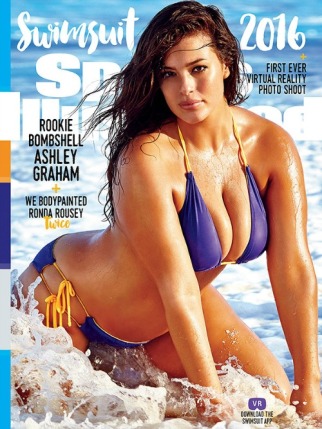
ashley-graham-si

I happen to think she’s gorgeous. And I also think she’d look better if she lost a few pounds, but hey – I’m not God. I’m also not the editor of Sports Illustrated, and most importantly – I’m not Ashley Graham. In all honesty, I feel a little gross even sitting here discussing her measurements as if those things define her. Her looks and health are her prerogative, and the decision to put her on the cover of Sports Illustrated is theirs.

Along comes former top model model Cheryl Tiegs. She doesn’t specifically call out Graham, but she is quite obviously referencing the SI cover. Here is what she says to E!:

“I don’t like that we’re talking about full-figured women, because it’s glamorizing them, because your waist should be smaller than 35 (inches),”

Regarding Graham specifically, Tiegs says:

“No, I don’t think it’s healthy. Her face is beautiful. Beautiful. But I don’t think it’s healthy in the long run.”

So basically – Tiegs is doing what Fat Acceptance Advocates HATE the most – invoking “health” as a way to put someone of larger proportions down.

I guess I should note here that Tiegs once modeled for cigarettes.  (Virginia Slims, appropriately enough). And let’s not forget her 1968 ad for tanning oil:
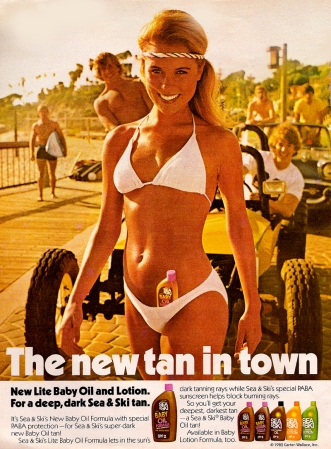
tan-adverts-1

In all fairness, I suppose that cigarettes and skin cancer are, in fact, pretty cool…

Plus Size Models and The Average Woman

Some people say that plus size models represent the average woman. But should they? And what the hell does it mean to be the average woman anyway?

Sure, the average woman is not rail thin. But she also doesn’t need to be a size 16.

People come in different shapes and sizes. And at 5’9”, a size 16 isn’t unreasonable, especially for someone with wide set hips. I have a very wide bone structure myself, so I could see how on a  rare occasion, someone might even be that size without having excess body fat.

But Graham does look a bit on the chubby side to me. And that’s OK – as long as she’s happy.  It seems that Graham is active and happy, and so I am not one to judge. And she’s still stunningly beautiful. So why NOT put her on a magazine cover?

On the other hand, Graham does NOT represent the average woman. I HATE this talk. The average woman is not a size 16, nor should she be. For the average woman, a size 16 is NOT curvy. It’s fat. Let’s not get it mixed up.

Which isn’t to say that MANY women aren’t a size 16. Of course many are. And for most of them, it’s not the healthiest place to be. Which is why, to some extent, I understand what Tiegs is getting at.  I still think she’s kind of a bitch.

Since When Do Models Represent HEALTH or Averages?

But here is what I’d like to know from Tiegs. Since when are models a picture of health? They’re not. They are very often exaggeration of an “ideal” body type. And they are very often pre-pubescent.

My point here is that NO, plus size models don’t (and shouldn’t) represent the average woman any more than regular models do. But so what?

Do ANY models represent the average woman?

And to Tiegs point – is it really any healthier to eat cotton balls and be rail thin? Is it particularly healthy for a 13 year old size 4 girl to be told she’ll be fired unless she loses weight?

…Watch the movie “Child Model” and tell me that models are a healthy bunch.

So, sure by medical standards, Graham is probably slightly overweight. Big deal. By society’s standards, Tiegs is probably a slight bitch. Luckily, there’s enough room on magazine covers for both of them

It’s Not Enough to Be Beautiful

The real problem is this.  It’s not enough to be beautiful or accomplished to end up on a magazine cover in the US. You must also be “perfect” with regards to your demographic.  And lord knows what “perfect” means.

Why is it that models are either insanely tall and microscopic or insanely tall and plus size?

Why is it that celebrities, who are insanely beautiful to begin with must be airbrushed thinner? Not only is it stupid, it’s also insane.

Where the hell are all the real human beings?  You know – the one’s who popped out of a vagina, and who might be perhaps – a size 8 or a size 10 or a size 12? The ones who occasionally eat pizza?

Why was a beautiful 13 year old girl (a size 4) told to either LOSE weight, or to gain weight to be plus size. She was scouted at her natural size 4. Why is she now modeling as a plus size?

Working in NYC, I am always amazed how many beautiful girls I see just walking the streets. Beauty really does come in all shapes and sizes. And in all races and at all ages.

People here are fashionable, they’re gorgeous, and they have character. Not everyone needs to be a stick. And not everyone is trying to be a size zero. Not everyone is flawless. But they are all worth celebrating. They all look great.

The Truth is This

It would be great if magazines celebrated the bodies of all kinds of women.

But Fat Acceptance isn’t that. Fat Acceptance is cool. It’s controversial. It’s good PR.

Sports Illustrated isn’t particularly brave or praiseworthy. And neither is Graham. They are just taking advantage of the zeitgeist. It would be stupid for any publication or model not to.

What would be praiseworthy in my mind?

To take a girl who is a size 4, or a size 8, or a size 10 – and feature her as she is. Without telling her to lose weight or to gain weight so that she could fit into a category. Without calling the bigger girl “plus size.”

And on the other hand – to stop using euphemisms like “full figured” and “curvy” to describe people who, in reality, are overweight. To stop pandering to people who would probably be better off if they loved their bodies enough to take care of them.

There are plenty of people who are “full figured” and “curvy” who are NOT overweight. There IS a difference.

The Pandering

If you love yourself and you’re overweight, that’s great. Everyone should love themselves.

But if you think any part of this whole “body acceptance” thing is about ACTUAL acceptance, then just know that you ARE being pandered to.

If this weren’t the case:

  •  a size 8, 10, or 12 would be just as acceptable to Sports Illustrated as a size 16. And yet it isn’t; AND
  • a size 6 would be just as acceptable on the runway as a size zero. And yet it isn’t.

What do you think?

unspecified-7201

If you love Fat Girls Fitness, subscribe to our bi-weekly newsletter.
(We won’t spam you)

And/or follow Fat Girls Fitness on Facebook 🙂

On Spanx, Dillards, and the Fat Acceptance Movement

People are talking these days. About:
1. Body Pride;
2. Sizeism (discrimination based on size); and
2. The fat acceptance movement

Just the other day, Arie announced it’s new campaign featuring size 12 model Barbie Ferreira. And perhaps you’ve come across one mother’s viral post floating on the internet:

unspecified-1.png

I believe strongly in body pride and self-confidence, no matter what. Everyone should love themselves. But I DO take issue with certain aspects of the fat acceptance movement.

The Dillards Incident

I was overweight as a child. I specifically recall an incident when I was about 10 years old. I went to children’s boutique named Denny’s in central New Jersey, to buy a Spice Girls T-shirt. The clerk came up to me and told me there was nothing in the store for me. I wish I could remember if we ended up buying the shirt.

I won’t forget that moment for as long as I live. Even though I was overweight, I always felt like a cool girl, and I didn’t think anyone at school made fun of me. But in that moment, it was like a grown woman was making fun of me. I wanted to shrivel up and die. I always wondered why the clerk felt the need to come up to me and say anything at all. Was she afraid I’d stretch out and rip all of the clothes?

Girls – young girls – are particularly susceptible to the influence of those around us, including  older women. Human beings are simply designed that way. There are so many influences telling us we are not good enough the way we are – whether its because of body weight, body hair, body features, or just whatever. Tina Fey wrote about it hilariously in Bossypants. These constant little signs of rejection are tragic.

But when it comes to the Dillard’s clerk (or in my case, the Denny’s clerk),  I’m going to go ahead and assume there was no ill-will intended. That’s because I feel comfortable assuming that the clerk at Dillard’s was not the brightest bulb, just as the clerk at Denny’s was not the sharpest pencil. These women are more likely socially inept than anything else. They don’t deserve our contempt, they deserve our empathy.

What’s more is this – the girl pictured above is adorable, and she is in fine shape. She has nothing to be embarrassed of, and nothing to hide. She wasn’t put on this earth to be an artificial construct, she is here to be herself. And if that means wearing Spanx, or if it means not wearing Spanx – then that’s her prerogative.

I personally choose the Spanx for myself, and maybe that’s because I’m a coward.

To her and her mother, I say “right on!”

The Fat Acceptance Movement

All of this is separate and apart from the fat acceptance movement, which I actually do take issue with.

But first, let me clarify two points.

  1. I’m a Libertarian. In every sense.  What I’m about to say here is only my opinion. I don’t claim to be right in any objective sense. It’s just what feels right for me – and I share my view because maybe it will resonate with you. So if you think the fat acceptance movement is the greatest thing to ever happen on earth, then great. But I don’t. I’d still love to break bread with you sometime. Preferably cheesy bread.
  2. What qualifies as fat?  When I say “fat” in reference to the body acceptance movement, I am not referring to people who are pleasantly plump, delightfully chubby, or even moderately obese. I’m talking about people who are well beyond anything that could possibly be considered a good weight.  And I’m not talking here about obesity in terms of BMI. I’m talking about obesity in terms of “you are fucking undeniably fat.”

The Good Aspects of the Fat Acceptance Movement

Fat acceptance advocates bring awareness to important issues such as weight discrimination in almost every single field. And that’s important.

I know for an absolute fact, as someone who has been at both ends of the spectrum, that fat people are treated differently. Very differently. By employers, professionals, doctors, teachers –  everyone. Even slightly overweight people are treated differently than their thin counterparts.

And this is something we should be mindful of. Both out of respect for others, and also to improve ourselves.

My Problems With the Fat Acceptance Movement 

People are not meant to be fat.

Yes, some of us are meant to put on weight easier than others. Some of us are not meant to be thin.  But with the exception of some very rare illnesses, no one is genetically destined to be very obese.

Obesity is a product of a modern lifestyle based on unnatural foods. These foods are marketed at us constantly from a very young age. We think these foods should make us feel full, but they don’t because they are devoid of nutrition. They are often designed to addict us, physically.  These foods are dangerous, and as far as I’m concerned, marketing them to children is criminal.

Obesity is not inevitable. I love that someone who is obese might love themselves, because I never could.  I also love that someone who is obese might feel nothing but pride and a positive self image. But I believe very strongly that obesity is nothing to celebrate. And having a positive self-image in an obese state does not preclude you from having an equally positive self-image in a healthy state.

That said, you should live your life however you want to live it.  But when Fat Acceptance Advocates begin to denounce doctors for blaming everything on their weight, what they forget is this – fat, itself, is an organ which promotes inflammation and injury. Fat changes your hormonal profile. If you are female, fat is very likely to make your period heavier, more difficult, and more irregular. Because of this, you might experience terrible mood swings, and become anemic. These aren’t rare side effects of fat – this is basically destiny.

Staying overweight also has negative effects on brain function, and increases how quickly we age. Waist circumference is a predictor of so many terrible outcomes.

But I don’t even need studies to know that being lighter feels better. I don’t sweat as much. There is less strain on my heart. I am no longer pre-occupied with food (says the girl with the fitness blog).

Now your health is not my business. And your appearance is not my business. But doctors are supposed to be healers. If anything, they don’t do nearly ENOUGH to promote sound nutritional choices, and to remind patients of the importance of maintaining a healthy weight. In fact, there are plenty of THIN people who are filled with dangerous visceral fat. These thin people may be at just as much risk of disease and cognitive decline as their overweight counterparts. And for the most part, doctors are failing them too.

This doesn’t mean overweight people shouldn’t be treated with respect. It doesn’t mean doctors shouldn’t take them seriously. But it does mean that it’s the doctor’s job to keep telling them to lose weight. Because whatever problem they are facing – it is exceedingly likely that its complicated by extra weight. And that might be true for even marginally overweight people. The same goes for thin people with dangerous visceral fat, or with poor blood results. Nutrition is medicine, and it is key.

In Denial 

When I read the literature of from fat acceptance circles, sometimes I am just surprised. Take this article from Every Day Feminism, for example, which suggests that being overweight doesn’t necessary mean you have poor nutrition. The author states that making assumptions based on weight is “oppressive” and suggests it is harmful for overweight people, “..to hear assumptions from dietitians and other healthcare practitioners that because of a physical characteristic, their weight, they must be unhealthy and engaging in poor self-care.”

The problem is simply that yes, being very overweight DOES mean you have poor nutrition.  And you might not even know it. Because nutrition is about more than how many calories and what nutrients go into your body. It’s about the health of your blood, your levels of inflammatory cytokines, your insulin and glucose levels, your gut microbiome and health, your arterial plaque, and your prevalent metabolic states. These factors are inextricably intertwined with your body weight and body fat percentage. This is basic. You can’t wish it away. And it’s not your doctor’s or nutritionist’s job to make you feel good about yourself. It’s their job to provide you with factual information.

There doesn’t have to be a disconnect between loving yourself and wanting to be healthy.

In fact, you don’t even have to be  healthy if you don’t want to be. Maybe you love being a giant fatass, and that’s great. Good health is not a mandate, it’s just a good idea.

But I won’t stand quietly by in the face of delusion. I’ll say my piece, especially since I’ve been there before. Every pound extra takes a toll on you health. It simply does. But that’s nobody’s business but your own.

unspecified-7.png

If you love Fat Girls Fitness, subscribe to our bi-weekly newsletter.
(We won’t spam you)

We’d love to hear about your progress.
Keep in touch with Fat Girls Fitness on Facebook 🙂